


The Hidden Hazard in Your Storm Kit Footwear
Establishing an inspection protocol for stored work boots can help to ensure their reliability in the field.
Some utility organizations purchase a stockpile of work boots to keep on hand for storm season, the same way they buy poles and transformers. The process usually goes something like this: order boots in bulk, place them in storage and hand them out when needed.
But boots do not keep the same way that poles and transformers do. The Foot Facts examined 87 documented work boot durability complaints across 42 brands, drawn from verified buyer reviews and trade forums (see https://thefootfacts.com/work-boots/boot-complaint-report/). Each complaint was sorted by what failed and when. Among them, seven pointed to out-of-the-box defects, including old boots sold as new merchandise. Another six described polyurethane soles breaking down as boots sat in storage, well before anyone tried to wear them.
Admittedly, six reports is not a big number, and the complaints only indicate boot failure; no failure rate or safe shelf life is provided. But this issue still deserves safety management consideration.
Polyurethane is a common component of work boot midsoles and outsoles. Moisture in the air can cause it to degrade (hydrolysis) whether boots are worn or not. The six complaints noted above describe barely used soles that crumbled, split or detached from the upper. One user reported soles breaking off barely used 6- or 7-year-old boots. Another described chunks of the sole detaching from a boot that had seen little use.
Because weakened polyurethane may go unnoticed in work boots on the shelf, employers must understand that boots purchased today could have been stored in a distributor’s warehouse for years.
Stockpile Problems
Work boots used daily get flexed, dried out and inspected; unused boots in storage do not. They sit in a sealed tote or box, sometimes in a humid building, until they are needed. Soles are rarely assessed until workers gear up for deployment. What does that mean for the crew member whose boot sole crumbles while working in a muddy right-of-way?
Per 29 CFR 1910.136(a), OSHA requires employers to “ensure that each affected employee uses protective footwear when working in areas where there is a danger of foot injuries due to falling or rolling objects, or objects piercing the sole, or when the use of protective footwear will protect the affected employee from an electrical hazard, such as a static-discharge or electric-shock hazard, that remains after the employer takes other necessary protective measures.”
Additionally, paragraph 1910.132(a) demands that protective equipment “be maintained in a sanitary and reliable condition.” A crumbling sole means a boot has failed the reliability test before a worker even laces it up.
Labeling Concern
Work boots with ASTM F2413 markings have met the performance standard’s requirements, which cover impact and compression at the toe. Additional ratings cover metatarsal, electrical hazard and puncture protection. But no rating or marking addresses sole lifespan, hydrolysis resistance or how long boots can sit in storage prior to use.
The bottom line here is that protection ratings do not cover storage failures. Even boots with recent F2413 markings could have soles that have already begun to break down.
Failure Checks and Rotation Planning
So, what steps can employers take to better ensure that the work boots they supply will adequately protect their employees?
Imposing a two-year storage limit for boots is one approach to consider. Bear in mind, however, that this is not a tested limit. Boot manufacturer guidance regarding shelf life, if available, should supersede the suggested two-year limit.
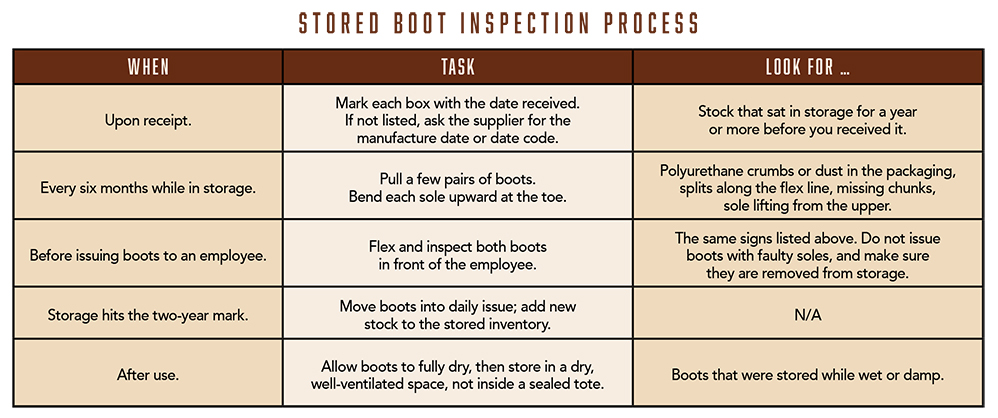
Here is another idea: Per OSHA 1910.137, Table I-5, we know that insulating rubber gloves must be tested “before first issue and every six months thereafter; upon indication that insulating value is suspect; after repair; and after use without protectors.” Along those same lines, the process below adds sole checks to the employer’s already established glove inspection protocol.
Final Reminders
Here are a few final reminders and words of advice on this topic:
- Treat boots as dated stock (i.e., first in, first out). Buy them in smaller lots more frequently instead of making one large purchase every few years.
- Mitigate hydrolysis by storing boots on open shelves in a dry, well-ventilated space.
- Add sole checks to the rubber goods inspection process.
- Pull all crumb-shedding boots from service as their condition is no longer reliable per 1910.132(a).
About the Author: Tony Bleak is editor and researcher at The Foot Facts (https://thefootfacts.com), an independent work-footwear research site. Contact him at tony@thefootfacts.com.
*****
How to Inspect a Polyurethane Sole
It only takes a few seconds to check a work boot for polyurethane failure. Hold the boot in one hand, bend the sole upward at the toe and look closely. A sturdy sole will flex and spring back. Decomposing soles often shed and split along the flex line. Chunks may be missing from the boot heel or edge. If you observe a flexed sole that peels away from the upper, the boot is no longer safe to wear. Be sure to check boot packaging as well; polyurethane crumbs inside are a red flag.